
A quick 5-minute walkthrough of our new offices in Oakland. Snide commentary does not represent opinions of Berrett-Koehler or its (other) employees or affiliates.
Tuesday

Ten Years A Citizen: Ten Learnings
 As I come close to celebrating my tenth year of US citizenship, I started thinking about when I first came here in 1989. Despite having traveled extensively around the world before that, I still had some serious cultural barriers to understand. Here are ten entertaining cultural lessons I learned during my first year in the states:
1. “What’s up?” is not, despite how it sounds, a question -– it’s just a way to say hello. It is also acceptable to just echo the sentiment right back -– resulting in two questions, neither of which requires an answer. In fact, actually proceeding to tell the asker all that is indeed “up” provokes great awkwardness and confusion.
2. A “party” does not always entail the usual things you find at parties such as music, food, and entertainment. Among younger people, a party just means there’s cheap liquor and a stale joint or two. I was frequently disappointed the first few times I was invited to “party” only to show up and find seven guys crushing beer cans on their foreheads.
3. It is not rare at all to find rabid sports fans who are grossly overweight.You would assume that a sports fan would stay fit and in shape by actively playing the sport that he or she is such a fan of. But no, you don't need to play the sport to be a fan. You can admire and tout the athleticism of others without having any urge to be athletic yourself. This disconnect does not surprise many Americans.
4. Despite what you see in many movies, only white people seem to high-five one another. Also, you should never actually ask for a high-five because that removes the coolness quotient and makes you look odd. Standing there with your open palm in the air and an expectant grin on your face while waiting for someone to execute the second half of the high-five, however, doesn’t look odd at all, apparently.
5. Losing weight is considered a laudable achievement. The ability to deny oneself excessive or unhealthy food is considered admirable. This is not to say that losing weight is not a healthy and good thing for many people; it's just odd that such an act is worthy of celebration.
6. People who have lots of crosses and crucifixes tattooed on their bodies aren't necessarily strong Christians. Having such tattoos or even wearing clothing or jewelry with crosses is considered a style statement and little else. In some cases, excessive religious iconography can be found on some decidedly un-Christian people.
7. Just because two people are “roommates,” it doesn’t mean that they actually share a single room. People who share a house but have their own bedrooms and bathrooms are still called “roommates.” For the longest time, I thought the majority of single Americans lived with other single Americans in one-bedroom domiciles.
8. On hot days, people –- mostly women –- like to put on bathing suits and lie by a swimming pool. Even though they are wearing swimwear, it’s hot, and they strategically place themselves next to water, they will never actually enter the pool. They just need to be in proximity of it. I had never before experienced a scenario where people would be crowded around the pool but with barely anyone actually in the pool.
9. Though Americans get a lot of flak for generalizing people of other geographical areas and being ignorant of various cultural and political borders, most people outside of the United States do the same thing to Americans. Americans are generalized as a single population who all share a common culture, but the truth is that some subcontinents divided by large oceans share more common values than Americans in different parts of the nation do.
10. People will tattoo just about anything on their bodies as long as it is not of their culture. East Asians never tattoo Chinese or Japanese characters on their bodies, but others do. Tribal tattoos are popular, but only with people who don't come from any of the lands the tribal tattoos originated from. South Asian Hindu iconography or Sanskrit will rarely be found on anyone of actual South Asian heritage.
But I've also made many wonderful discoveries about this great nation. Here's just one (and my favorite):
No matter how well they know (or don’t know) you, if you do not have a place to go on Thanksgiving Day, countless friends and acquaintances will insist upon inviting you into their homes, where you will meet all those odd relatives and family members they told you they never wanted you to meet. And they will feed you until you are bursting and send you home with enough food for a week. It’s an unspoken rule: no one spends Thanksgiving alone if you can help it.
Five Facts About Publishing and Books in China

Jim Bryant is the CEO of Trajectory, Inc. and has negotiated some of the biggest distribution deals for books in China. Here are five myths he dispels about the book market in China:
Myth #1: Except for small urban pockets, the majority of Chinese rarely access the internet and so e-books are just not viable.
With over 600 million people using the Internet and 80% or more are accessing the web through their smart phones, the digital marketplace is impressive to say the least. A majority of people in China prefer to read on their mobile devices, research shows (especially since the average smartphone screen in China is considerably larger than standard iPhone-size screens -- which makes for a much easier read).
Myth #2: The government's censorship process stops a lot of work from getting through.
The Chinese government has recently become receptive to importing a larger volume of foreign published titles. The official policy on international engagement is summarized in this simple statement :
“请进来,走出去”
qing jinlai, zou chuqu (welcome in, going out).
It is true that all titles imported into the country must be submitted to a government agency for approval, and that can be problematic, but there are ways around it. At Trajectory, we process our titles through a Natural Language Processing engine that helps us identify troublesome topics. By filtering obviously objectionable titles and highlighting titles that contain marginally controversial subjects, we have been able to accelerate the approval process.
Myth #3: My titles need to be translated into Chinese since no one speaks English there.
While there is an advantage in having the titles available in Simplified Chinese, there is a large market for English language editions. Another fact to consider is that more people speak English in China than in the US.
Myth #4: Books are priced so low in China due to competition, local economies, and the exchange rate, that earnings will be paltry.
The prices of books have actually been going up since 2005. Actually there are advantages to competitive pricing in light of the potential demand and scale of the market. The potential volume of sales will often more than compensate for lower individual unit sales income.
Myth #5: Online piracy is a serious problem in China that people should be concerned about.
While China does not have the same level of copyright enforcement as in the United States and other countries, the Chinese Government has, in tandem with some of the largest national service providers, been taking steps to mitigate piracy. The Chinese Government recognizes the reciprocal responsibility in protecting foreign publishers’ rights as it is encouraging Chinese publishers to export their titles to new markets where they obviously need to be protected.
What are the big new book trends are in China? Open Sesame on all fronts! The market for imported books is growing exponentially along with the expected migration to preferred digital formats. There are certainly first mover advantages to be realized as well as the unique opportunity to build brand recognition while the volume of content is comparatively low.
Wednesday
Five Lessons from the 2014 London Book Fair
by Johanna Vondeling
Subsidiary Rights Director Maria Jesus Aguilo, Senior Subsidiary Rights Manager Catherine Lengronne, and I recently returned from the 2014 London Book Fair, which BK staff have been attending every year since 1996. While there, we met with 62 publishing partners from 23 different countries, as well as with scores of digital partners and other collaborators from across the globe. As always, we enjoyed doing business and raising a glass of wine with old friends and new acquaintances. This year’s fair was bittersweet, in that it’s the last time the fair will be held at Earl’s Court, which the city is demolishing to make way for residential and retail development. Next year, the fair is moving to Olympia London.
Subsidiary Rights Director Maria Jesus Aguilo, Senior Subsidiary Rights Manager Catherine Lengronne, and I recently returned from the 2014 London Book Fair, which BK staff have been attending every year since 1996. While there, we met with 62 publishing partners from 23 different countries, as well as with scores of digital partners and other collaborators from across the globe. As always, we enjoyed doing business and raising a glass of wine with old friends and new acquaintances. This year’s fair was bittersweet, in that it’s the last time the fair will be held at Earl’s Court, which the city is demolishing to make way for residential and retail development. Next year, the fair is moving to Olympia London.
 |
| Johanna amidst the hustle and bustle |
1. Translation Market On the Mend: Since the global financial crisis, we’ve noted a
fairly gloomy attitude among our international publishing partners. This year, we detected a refreshingly upbeat
attitude. Advances, which had been
dropping for several years, seem to have found their new normal.
2. You Never Know: We learn this lesson over and over again every year. It’s impossible to predict what’s going to
catch international publishers’ attention. This year, the most requested BK book was the forthcoming personal
development title, “Your Life Isn’t For You,” by blogger Seth Adam Smith. But this wasn’t
indicative of any particular
trend.Titles on subjects as
wide-ranging as personal optimism, rebalancing society, and motivation in the
workplace were nearly as popular. So it
pays to never stop pitching!
 |
| Dinner with folks from Gabal |
is the holy grail of revenue.
4. Disruption in the Library Space: Local governments and universities are building
fewer libraries and buying fewer books, but there’s still a lot of money in the
pot. Libraries are increasingly spending
that money on digital content, which is helping to lure younger readers back
into the library space. As a result, the
marketplace is in flux. Proquest just
acquired EBL, while Overdrive and EBSCO are battling it out for market
share. Meanwhile, new entrants are
crafting new business models to better serve the unique and cost-conscious
needs of libraries in the US and around the world. Prediction: more consolidation ahead.
 |
| Maria Jesus and Catherine hold court |
Personally, we three love
attending LBF in no small part because it’s both an opportunity to reconnect
with our international friends (we shared a lovely — if jet lagged -- meal with the
stunning women from our German partner Gabal) and to savor the annual ritual of
breaking bread with our local Bay Area friends at North Atlantic, whom we
rarely see at home. Renewing these
friendships at the fair always makes our annual stay in London fun-filled and memorable.
 |
| With our North Atlantic pals |
The Inaugural Writing for Change Workshop (20th February, 2014 in Perth, Australia)
A few notes by Maarten van der Wall
The Setting:
 In a magnificent old
timber-lined room on the University of Western Australia Claremont Campus inPerth, on a typically hot summer’s day, fifty fellow travelers embarked on a
journey of exploration to support the emergence of this Writing for Change
collaboration with BK and its author community.
In a magnificent old
timber-lined room on the University of Western Australia Claremont Campus inPerth, on a typically hot summer’s day, fifty fellow travelers embarked on a
journey of exploration to support the emergence of this Writing for Change
collaboration with BK and its author community.
The People:
There to set the
scene for the attentive audience were BK author Jennifer Kahnweiler, who was
visiting from the US, local Perth writer and poet, Annamaria Weldon, and the
facilitation team of Michael Prince, Renu Burr and Maarten van der Wall.

The First Conversation:
The first course of
this writer’s feast was rich fare, as we enjoyed an exhilarating conversation
between Jennifer and Annamaria, convened by Michael, during which they shared
their wisdom and experience and responded with a refreshing honesty and clarity
to questions from the audience.
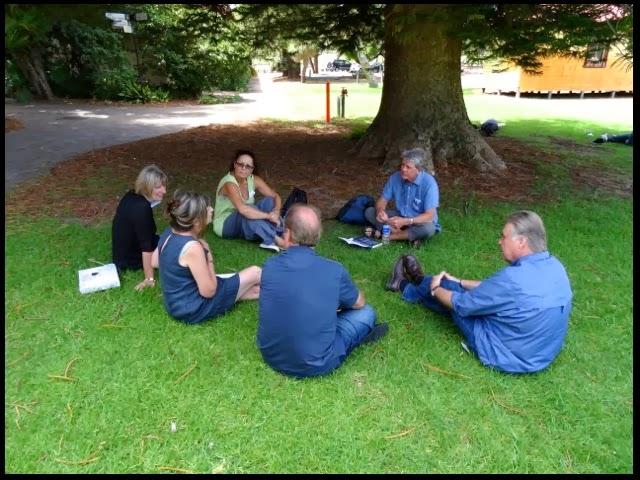 Following a very
welcome mid-morning break for refreshments, and for some escape from the heat
(our air-conditioning had taken an unfortunate break for the holidays), it was
time for the audience to play its part.
Following a very
welcome mid-morning break for refreshments, and for some escape from the heat
(our air-conditioning had taken an unfortunate break for the holidays), it was
time for the audience to play its part. 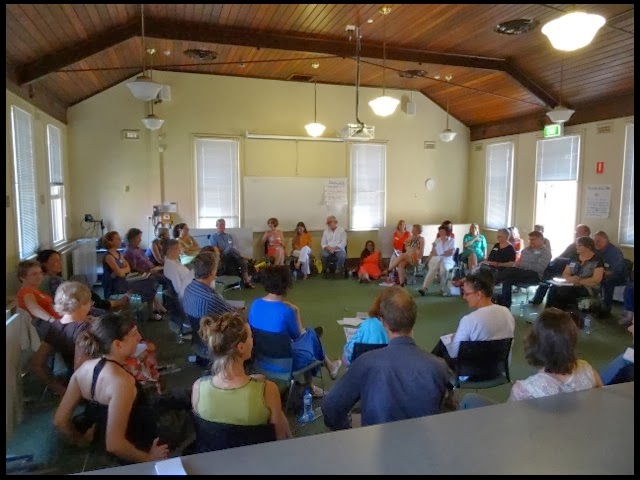
And, for a few exciting and energy-filled hours together, we all enjoyed the experience of being part of the Writers for Change community!
What’s next?
Writing for Change is an emergent story in our West Australian context, as demonstrated by the number of people who attended the workshop and expressed interest in being part of this continuing narrative. With that clearly in mind, the organizers look forward to building a continuing and energizing collaboration with BK and its author community and to being an influential part of the local writing scene for many years to come.
Our Thanks:
We are grateful for the ongoing support and
encouragement offered by Johanna Vondeling and the BK author community and for
the provision of the venue by Terri-Ann White of UWA Publishing. And many, many
thanks go to Gourmet Ganesha, Meenakshi Burr and Judy Shearwood for the wonderful refreshments.
Tuesday
Ten Lessons Learned at Forty-Four
 I turned 44 some weeks back. Dammit.
I’ve come to realize that getting older, for me, is about recognizing that everything is ultimately about moving to the opposite end of your previous station. Here are ten examples:
1. When you’re younger, you never seem to gain weight, and if you do, you can lose it over a weekend. When you’re older, you can gain weight over a weekend and never be able to lose it.
2. When you’re younger, you dress down on week days and dress up on the weekends. When you’re older, you dress up on week days and dress down on the weekend.
3. When you’re younger, you dread having a weekend with absolutely no plans. When you’re older, you cherish weekends with no plans.
4. When you’re younger, sleep is a necessary break in the path towards your goals. When you’re older, sleep is the goal.
5. When you’re younger, you think you’re mature for your age. When you get older, you realize how ridiculously immature you really are.
6. When you’re younger, you hate the boomers for "selling out." When you get older, have kids, a mortgage, health issues, and loans, you look everywhere for opportunities to sell out.
7. When you’re younger, your mind has to keep up with your body. When you’re older, your body needs to keep up with your mind.
8. When you’re younger, you have a growing variety of friends with different personalities all across the world. When you’re older, you downsize your friends according to maintenance effort required and proximity of residence.
9. When you’re younger, you use facial hair and hairstyles to appear older. When you’re older, facial hair and hairstyles are to conceal the flaws of aging.
10. When you’re younger, you think people who are weird or eccentric are smart. When you’re older, you realize that there is no correlation between weirdness and intelligence.
Friday
Six Things You Should Expect from Your Literary Agent
 We’ve worked with several literary agents and agencies, and we have
seen some exemplary agenting -- and some downright rotten practices as
well. Here are six things you have the right to expect from your agent:
We’ve worked with several literary agents and agencies, and we have
seen some exemplary agenting -- and some downright rotten practices as
well. Here are six things you have the right to expect from your agent:1. No requests for money up front
A proper literary agent asks for no money up front. We have heard of countless variations on the money-up-front scheme, including “administrative fees” and “reading fees” and such. We're not buying it. In the many years we’ve been publishing books, we’ve never dealt with an agent who asks for anything up front from authors. An agent gets paid only when you get paid. (And that cut is rarely more than the standard 15% in this industry.)
2. Success stories and greatest hits
We’ve seen too many authors who are just so happy for representation that they sign with an agent who really has no weight in the industry. It takes nothing to call yourself an agent. And there is no governing body, so authors need to do their homework and discern quality for themselves. Ask potential agents about their successes and bestselling books as well as what publishers and authors they’ve worked with. A good agent will always be forthcoming and may even let you speak to other authors he or she has represented.
3. An expiry date — just in case
Once you sign with an agent, you have given that agent the exclusive right to represent you and your work. You have to then trust the agent to place the work somewhere, but you also need to protect yourself in case your agent -- whom you are contractually obligated to -- isn't working too hard on your behalf. We’ve heard stories of authors who got so fed up with their agent not doing anything that they signed a contract from a publisher themselves, only to find out later that the agent, contractually, gets 15% of the take even if he or she did absolutely nothing. So be sure your agreement states that if a particular number of months pass with no offer of a contract, you have the right to dissolve the agreement with your agent.
4. Personalized representation by an agent who knows you
Whether the agent is a one-person operation (many great ones are) or part of a conglomerate, each agent represents a certain number of authors. You have the right to ask how many authors the agent is actively representing. This is a case where more is not better. Many agents will take on hundreds of authors and projects because they play a numbers game by throwing all the projects against the wall and seeing which one sticks. Usually, the more successful an agent is, the smaller the number of clients he or she will have (although the clients themselves will often be ridiculously high profile). But there are always exceptions to this rule, and there are no magic numbers here. Just be aware.
5. Bargaining on your behalf
Agents should bargain for the best deal for their client — not just for money and royalties but also for marketing budgets and ad placement and provisions like that. Sometimes, however, agents try to justify their role by overreaching and bargaining for rights that really aren’t in your best interests. So you’ll get an additional 30% royalty for Mongolian rights? Well, that’s lovely, but we’re talking about $12 or so — and that’s if someone in Mongolia wants your book. Why not haggle for a bigger ad budget instead? An agent should tell you what he or she is negotiating for and why.
6. A dissolution clause in your agreement
Your agent is your agent for the life of the book and will continue to get a 15% cut for that length of time. But even great friendships often end and sometimes author-agent partnerships also end. So be sure you have a clause in the contract that allows the two of you to dissolve the partnership without any financial backlash. Even famous authors have suffered without having these terms clearly defined in an agreement.
Monday
Top 15 "Innocent" Phrases That Are Totally Annoying
 Everyone knows those annoying words and terms we use that have become meaningless ("synergy," "organic," "incentivize," and others), but there remain many phrases that we're all guilty of using every day that are equally pointless and frustrating.
After reading this post, you are forbidden from using any of these phrases. Forever!
1. "Just to be clear...": Why not just say, "You morons don't seem to be understanding me so let me hammer this point home."
2. "That's my 2 cents": Skip the humility, grasshopper. If what you had to say was really worth two cents, you should have just remained silent.
3. "No offense": Usually said right before something offensive is said. Issuing a disclaimer doesn't help.
4. "I don't mean to be difficult.": Um, if you are aware that you are being difficult, which is precisely why you would say this, then you do mean to be difficult.
5. "I hear what you're saying.": Brilliant, your ears work. Now what?
6. "I'm just saying…": Yes, we know this because it is coming from you and you are saying it. Thank you, Captain Obvious
7. "At the end of the day...": Why is the end of the day the finality of all things? Things are going to be just as messed up the following morning, you know.
8. "Thank you for your patience": Usually spoken by airline staff over delays or construction crews blocking roads — don't thank us for something we have no choice over, it's patronizing.
9. "I could care less.": This is annoying because the phrase is "I COULDN'T care less." The phrase makes no damn sense otherwise!
10. "To be honest…": You mean in contrast to all the other times when you're just spinning bull?
11. "Going forward…": Because going backward is not really possible, Marty McFly, so why bother?
12. "With all due respect…": And by this, I mean I have no respect for you at all.
13. "Needless to say…": But you just need to say it anyway?
14. "Don't go there.": Well, I wasn't going to until you said that, now I am going to go all up in there and then some.
15. "Fairly unique…": It's a bit like saying "mildly devastated" or "stunningly passable."
This list is inspired by my mentor and the guru of management-speak, Bob Lewis, who added these two gems to the mix:
16. "We need to plan for the future...": Hot damn! Of all the periods of time to plan for, it would never have occurred to me to plan for that!
17. "Past experience tells us that...": Probably because future experience hasn't told us anything yet, and won't until the present passes it by.
Thursday
Five Lies Writers Are Told
 Because the world of publishing remains inscrutable, many writers
find themselves being told lies by well-meaning friends and colleagues.
These friends and colleagues don’t intend to mislead their
writer-friends, but they do.
Because the world of publishing remains inscrutable, many writers
find themselves being told lies by well-meaning friends and colleagues.
These friends and colleagues don’t intend to mislead their
writer-friends, but they do.Here are five of the most common bits of “advice” given to writers by people who really don’t know better.
1. “Be careful about circulating this around. Someone will steal it.”
Incidents of literary theft remain rare, despite what you may see in the movies or elsewhere. But the best way to establish ownership of a work is to publish it — on a blog on the web, in an article, or whatever (you don’t have to publish the whole thing, just the core idea). Letting the world know that you wrote it and interacting with those who read it and offer feedback is the best way to keep someone from stealing it. The great thing about the web and all publications in general — they record the date on which your article was published, so if someone attempts to steal your work, they would need to show an earlier date of publication to yours.
2. “If you’ve got the whole manuscript draft already, skip the proposal and just send the whole thing to the publisher for consideration for publication.”
No, please don’t do that. A book proposal contains all sorts of valuable information such as biographical information, marketing ideas, competing titles, details about length and format, and much more — all of which are needed to assess a potential publication. Also, in no publishing house will you find an employee whose sole responsibility is to review incoming proposals. This means that the person handling this duty in any given house already does a bunch of other things. They don’t have the time to read your entire manuscript to see if your ideas are any good, but they do have the time to read the synopsis and chapter outline that will be part of your proposal packet.
3. “Get an agent. No publisher takes you seriously unless you have representation.”
Getting an agent is a very good idea: they can negotiate the best deal for you and often have connections with editors in numerous publishing houses. And because of this belief, agents receive way more proposals than most publishers, and seeing as most literary agencies operate with a staff in the single digits, getting a response can be tricky if not time-consuming. But not all publishers require representation. Check out the proposal guidelines on the websites of publishers who publish in your genre. You’d be surprised how many established houses don’t require agency representation.
4. “That idea is so good, you should copyright this work and maybe even trademark the title.”
You can’t trademark a book title, nor are trademarked names protected by law when it comes to book titles. This is that whole freedom of the press thing — if you want to write a scathing critique of Microsoft, you should be able to use the trademarked name Microsoft in your title if you want. Keep in mind that limitations exist around such usage, however — for example, it has to be clear that you are not representing Microsoft in any way or profiting from their name in titling your book that way (unless, of course, you get permission from them to do so first). And no, while you can copyright works, you can’t copyright ideas because the law recognizes that two people can have the same idea at the same time without ever having met each other. If someone has the same idea as you, that’s just tough (unless they have the same idea and the same characters and names for things as you do — then it’s easier to prove copyright violation).
5. “My friend is a lawyer and he can look at the publication contract and make sure everything is good.”
Here’s the thing: publication contracts are not like regular contacts. There are different factors and conditions based on the restrictions put upon us by this industry, so unless the lawyer is someone who specifically deals with publishing agreements, he or she is going to just annoy the publisher by making ridiculous demands on your behalf, which will not help you in any way. Don’t get me wrong, having a qualified lawyer is a very good thing when it comes to looking over contracts, but the key word is QUALIFIED — competent in publishing contracts. Getting your tax attorney brother-in-law to give your contract the once-over is not going to help you, I assure you.
Monday
There Is Method to My Madness
 I am currently collaborating with several teams of BK
community members to establish a new nonprofit organization affiliated with
Berrett-Koehler Publishers, which we have named the Berrett-Koehler
Foundation.
I am currently collaborating with several teams of BK
community members to establish a new nonprofit organization affiliated with
Berrett-Koehler Publishers, which we have named the Berrett-Koehler
Foundation.
There are many reasons why it is insane for me to be
involved in this endeavor, including the fact that I have no free time to
devote to this quest (because I already have two full-time jobs as BK president
and as one of our book acquisition editors) as well as the reality that fundraising
is a huge challenge for nonprofit organizations and a heavy fundraising burden
for the Foundation will fall on me as BK president.
Why, then, do I
believe that the Berrett-Koehler Foundation is so important that I am devoting
a great deal of my time to establishing it despite good reasons not to pursue
this? There are several reasons I am
deeply committed to this quest:
1. The Berrett-Koehler Foundation is a way
to take BK’s mission of creating a world that works for all deeper
into the world. It will help put into practice ideas and methods that
create deep positive systems change.
2. The Foundation opens up another front
for increasing BK’s impact. It will reach
audiences that we don't currently reach effectively through our books —
especially young leaders around the world — and help them master and apply new
ways of leading and collaborating that they seldom learn from schools or from traditional
leadership development programs.
3. The Foundation is a means of expanding
the BK community around the world, especially among younger and less affluent
groups, and helping BK community members connect with and support each other.
4. The Foundation can help preserve the
independence, mission focus, and values of Berrett-Koehler Publishers by
becoming a significant long-term shareholder of BK stock (which I and other BK
shareholders intend to donate to it).
So, is there method to my madness? You decide. Please read this two-page brochure about the Foundation. And please check out the Foundation website.
Please email me personally at spiersanti@bkpub.com if
you would like to learn more about the Berrett-Koehler Foundation or to find
out how you could support it or get involved in some way.
Thank you,
Steve Piersanti
President
Berrett-Koehler Publishers
Subscribe to:
Posts (Atom)